How to improve your car's stereo imaging and soundstage
A guide to making your car a great place to enjoy music

With a properly tweaked soundstage and clear imaging, your car or truck can be a fantastic place to listen to music. In this article, we'll explain how to compensate for some of the vehicle's natural limitations in order to create a top-notch listening environment.
Achieving great musical soundstaging and imaging is a matter of understanding your audio components, and how they interact with your vehicle and the people sitting in it. With a properly tweaked audio system, your car or truck can be a fantastic place to listen to music. In this article, we'll explain how to compensate for some of the vehicle's natural limitations in order to create a top-notch listening environment.
Soundstaging vs. imaging
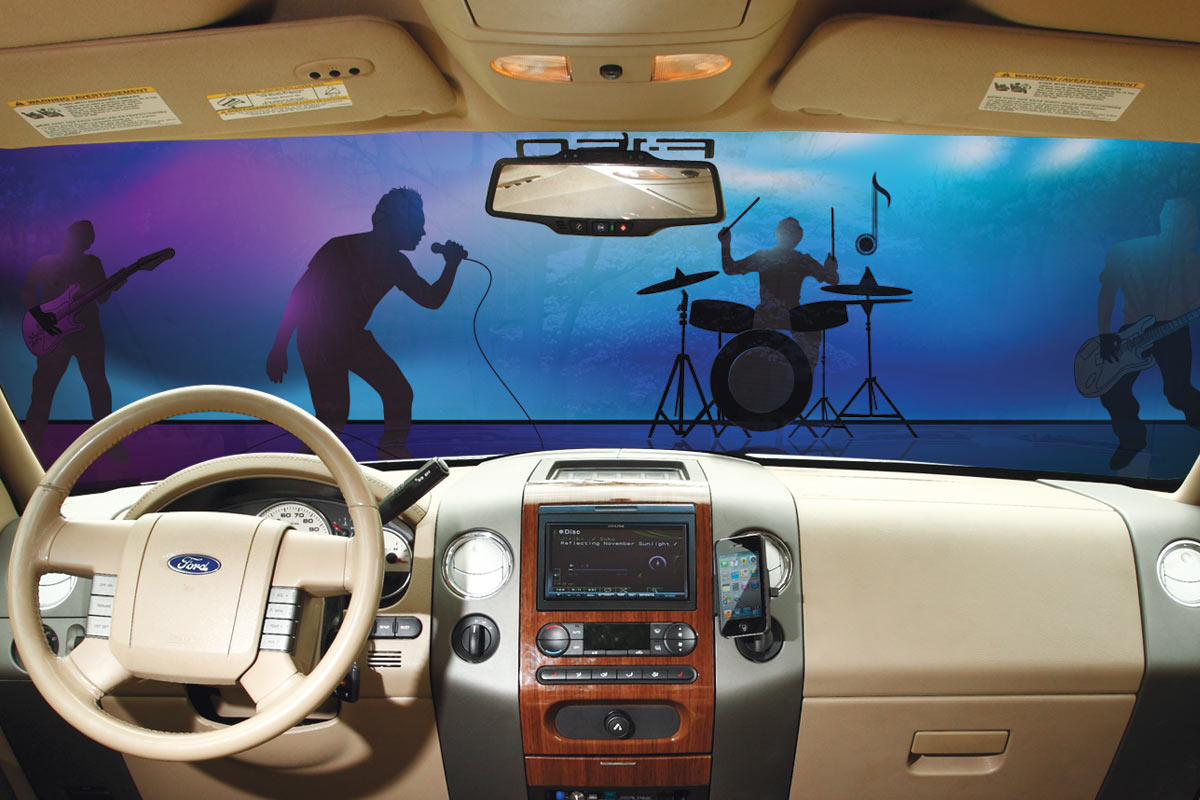
First, let's explain the concepts central to this discussion. When listening to music in your vehicle, the speakers themselves should seem to disappear, replaced instead by a spatial arrangement of music sources in front of you. The music should fill the space from left to center to right across the dashboard.
Soundstaging refers to how the music is positioned in the space inside your car — the "stage" across which the instruments are placed. A properly tuned system makes it sound like the music is coming from in front of you, on the dashboard, rather than from the doors.
Imaging describes how precisely you can hear the individual instruments positioned on that soundstage. In a system with superior imaging, you should be able to close your eyes and envision where the instruments were positioned on stage, from right to left.
Why car soundstage is hard to get right
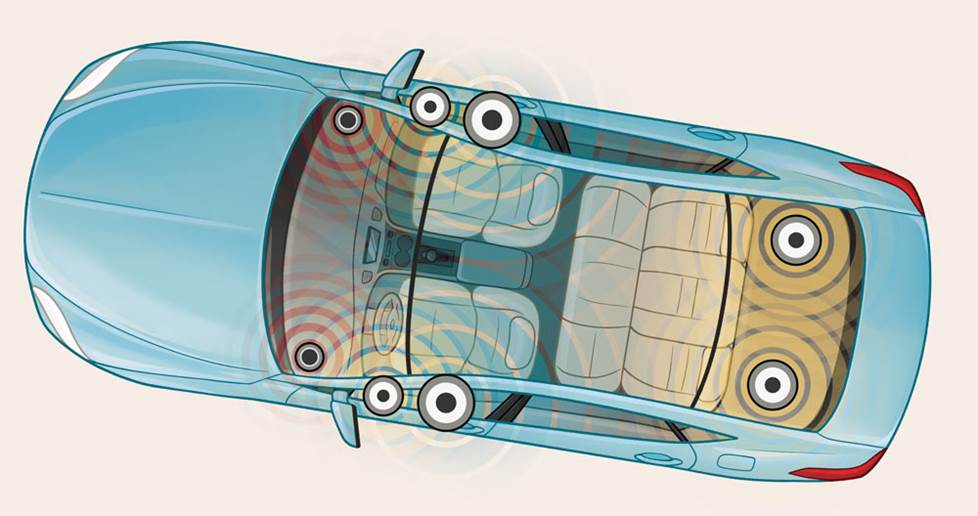
When you listen to tunes at home, you probably don't make a habit of planting yourself smack dab in front of your left speaker. If you did, you'd be missing out on the detail the right driver has to offer, as well as the spaciousness of a complete stereo image. Yet when you listen to music in the driver's seat of your car, and you have conventional speakers in your doors or dash, you probably get the same type of imbalanced listening experience.
Add to that the fact that your vehicle interior is mostly glass and plastic, which are reflective, and fabric or leather, which are more absorbent, and the sound waves just get bounced and absorbed randomly throughout the listening environment.
The disadvantages of "side-biased" listening
The music on your left reaches you before the music on your right. Within certain bandwidths, this imbalance may seem to alter your system's response, emphasizing some frequencies over others. The sounds on your left may also seem louder, distorting the soundstage.
Equalizing the lengths of sound paths
To get proper imaging, the path lengths between your speakers and your ears need to be as close to equal as possible. These paths should be unobstructed as well. If your left door speaker lies about two-and-a-half feet from your left ear and your right door speaker about five feet from your right ear, you won't hear balanced sound. Playing with the receiver's balance control can help the driver's listening experience, but it throws the image out of whack for the person in the passenger seat.
Use time alignment to fix the soundstage
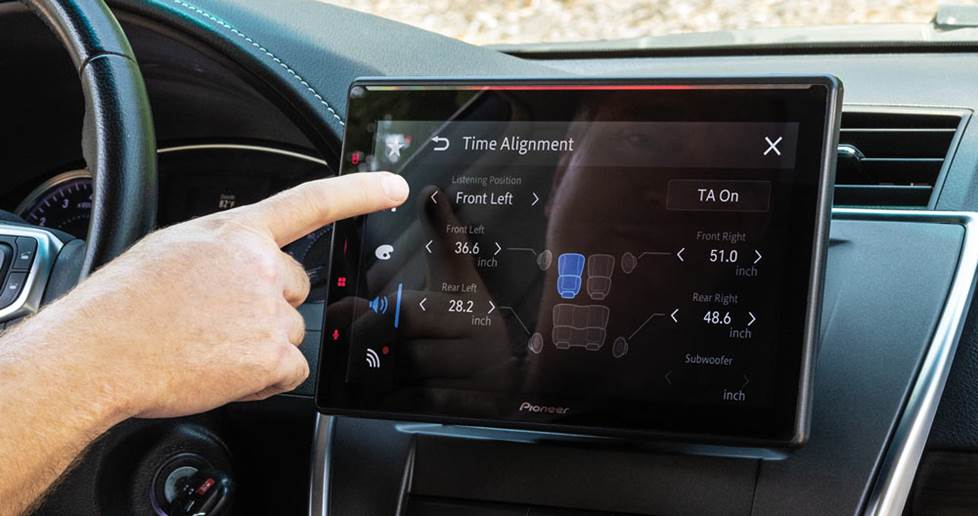
You can overcome unequal path lengths by purchasing an in-dash stereo with digital time correction. Time correction allows you to compensate for speaker placement by adjusting the speed at which the audio signal reaches individual speakers. Using the speaker furthest from your ears as a reference point, you calculate the amount of time that speakers closer to you need to be delayed so that all sounds arrive at your ears at the same time.
You can also find time alignment tools in outboard digital signal processors (DSP) or amplifiers that have a built-in DSP. More on this topic below.
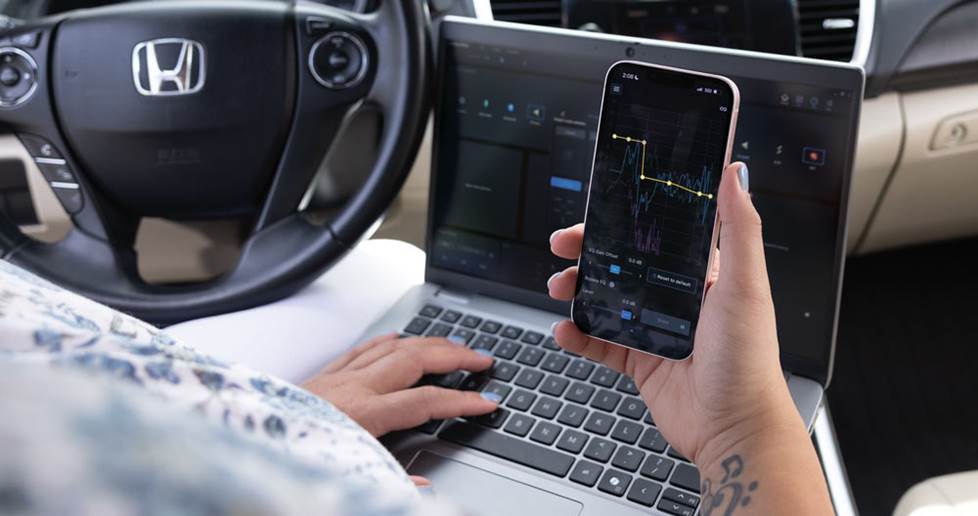
Some digital signal processors can dial in your vehicle's sound — including time alignment — using smartphone apps or a connection to your laptop.
Component speaker systems help the staging
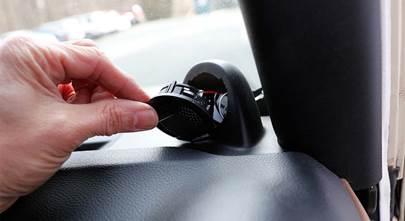
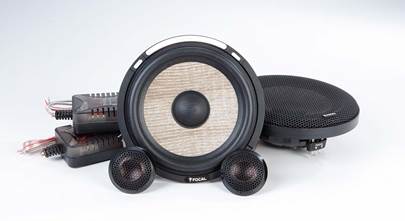
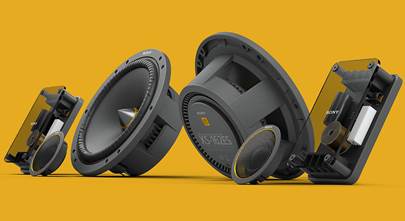
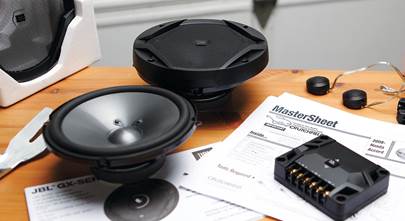
Component speaker systems can help because they let you mount the tweeters higher in the vehicle. The higher musical frequencies are more directionally oriented, so having tweeters mounted on the upper door panels or in the dash corners automatically raises the overall soundstage. Many component sets also let you adjust the firing angle of the tweeters to further optimize imaging. (Keep this feature in mind when shopping for add-on tweeters.)
Read our guide to tuning your car speakers for details.
Rear fill — why do you need rear speakers?
If you want the soundstaging to appear on the dash, do you even need rear speakers? We say yes.
Once you have your front speakers installed to your liking, you'll want to make sure that your rear speakers are doing their part to create an ideal soundstage. While personal taste plays a role here, most experts agree that you should adjust the volume level for rear speakers so that you're barely conscious of their presence.
While your front speakers should give you the best midrange and high frequencies possible, your rear speakers can be conventional coaxials or low frequency drivers. Their purpose is to add ambience and depth to your forward soundstage. If they reveal too much high-frequency information, they'll "pull" the stereo image to the rear of your vehicle, away from where you want it.
Pioneer SPHERA adds Dolby Atmos® to the mix
Pioneer's new SPHERA technology brings the spatial audio experience to traditional four-channel car audio using autotuning calibration inside your vehicle. Once SPHERA has analyzed your car's interior, your car's four speakers can play Dolby Atmos encoded music for enveloping audio with a raised soundstage and dramatic channel separation.
Read our expert review of Pioneer SPHERA for more on how this technology performs.
How to adjust the bass
If you're running a subwoofer in your trunk, you want to avoid the sensation that all the bass is coming from the rear of the car. You don't want it sound like the bass player is dancing her way from your trunk to your front doors as she plays higher up the neck.
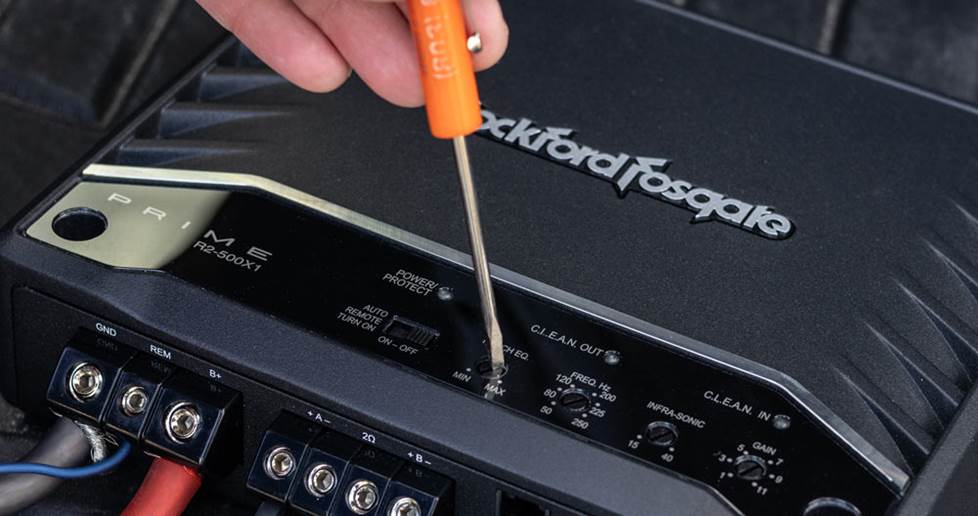
Whether the crossover is in your amplifier or in-dash stereo, set the high-pass filters to feed your front speakers the lowest frequencies they can safely handle. Start with your low-pass filter set as low as possible, then raise the crossover point until you hear the "sweet spot" — the point at which the bass notes sound clearly defined, punchy, and in front of you. This setup allows some bass to filter from your front speakers and restricts your subwoofer to the low bass that is very difficult to localize and that it's built to deliver.
Read our guide to tuning your subwoofers for details.
DSP for the win
Today, we are fortunate that many amplifiers have built-in DSP — digital signal processing. An amplifier with built-in DSP or an outboard digital signal processor both do the same thing: they let you adjust and tweak the sound to improve soundstaging in your vehicle.
Many of these systems have computer or smartphone apps to help you tune the sound in your vehicle, taking into account your speaker placement, gear, and power. Once you've spent some time getting familiar with the DSP settings and controls, you can create a truly fine-tuned sound in your vehicle.
Learn more about digital signal processors and how to add them to your system.
Quick steps to good soundstaging
Here is a step-by-step process to creating proper soundstaging in your car.
- Set the stereo's balance and fader controls to 'flat' or 'center'. Turn off any EQ curves or bass boost. You want to start with your stereo's plain, neutral sound.
- Increase the tweeter level (if possible) or fade the sound slightly forward.
- Turn down the rear speakers so that you barely notice them. This is also achieved by adjusting the fader toward the front if you don't have specific front/rear volume controls.
- Use time alignment (either in your stereo or your DSP) to remove side-bias effects. You want sound from the left and right speakers to reach your ears at the same time.
- Use your subwoofer amp's crossover to tighten up the bass.
- Adjust your EQ to remove any harsh high frequencies and make subtle tweaks as needed.
Play a variety of your favorite music as you dial in and finesse the settings with your EQ. You'll be surprised at how much of a difference this process can make. Don't worry about trying to get things perfect. Focus on making your music sound fully present, in front of you, with the individual instruments clearly placed across the dash.
Common mistakes when sound tuning
We've already mentioned this stuff above, but it bears repeating. These are some of the most common mistakes people make when tuning their audio system.
- Too much bass. If the subs are slammin' in the back, it spoils the illusion of having the band localized in front of you. And that instense bass can overwhelm the higher frequencies.
- Too much rear fill or overly relying on rear speakers. If the audio from your rear speakers is too strong, you end up with the sound stage behind you. Instead of being in the front row, it feels like you're standing with your back to the band.
- No time alignment. Without proper time alignment, the sound from the left speaker reaches your ears a fraction of a second faster than the right. That makes the notes and instruments playing through the right speaker sound weaker and less prominent.
Testing your system
When you have all your components in place, test your system to see that it's imaging properly. Spend some time listening to other people's set-ups, too. Rather than attempting to precisely duplicate the systems you like, try to pick up general concepts and techniques, keeping in mind that every vehicle differs acoustically. What sounds great in a trophy-winning Camaro may muddy up the sound of your BMW. Besides, some of us like very precise imaging, while others among us prefer sound that is a little more spacious and open.
In the final analysis, the stereo image that suits your tastes is the one that's right for you. So, trust your ears.

Next steps — updgrading and tuning your audio system
If you already have a great sound system in your car, that's awesome. All you need to do is apply the concepts above. If you need new speakers, a stereo with in-depth sound controls, or an amplifier with built-in DSP, contact our expert advisors. They can help find the gear that will work in your vehicle and will do what you need it to do.
And when you purchase your gear from us, you'll get access to our tech support team. They'll help you install it and set it up properly, and even help walk you through tuning it perfection.



Troy
Posted on 6/16/2023
Built home speakers for 15 years....want to upgrade my truck speakers? Stock speakers usually need help! So many opinions but obviously they're just trying to sell a product
Troy
Posted on 6/16/2023
Built home speakers for 15 years....want to upgrade my truck speakers? Stock speakers usually need help! So many opinions but obviously they're just trying to sell a product
Daniel from Las Vegas
Posted on 3/19/2023
I have a 2007 Acura RDX with factory premium system. I am adding a Kicker 4 channel key amp with DSP. I would like to upgrade my front speakers. Any recommendations? Should I get components or just coaxial? Thank you
Richard Guerra from San Jose
Posted on 2/2/2022
After reading your suggestions on what sound your car stereo should produce, I realize that I needed to re-think my approach to up grading the speaker replacements and any accessories that I might need. My goal is to greatly improve my car stereo sound in my 2019 Camry SE, without doing alot of custom cutting or fabrication. I want the installation to look like factory standard. So now I have alot of research ahead of me? But I would rather do the research and do it right from the start, instead of diving head first.
Alexander H. from Crutchfield
Posted on 12/8/2021
Jon, yes. However, many stereos and DSPs allow you to have multiple EQ presets that account for when you have passengers in the vehicle. For instance, you might have a "Front row" preset tuned for both driver and passenger, and selecting it is as simple as pressing a button.
Jon
Posted on 12/7/2021
If a car stereo is tuned to sound perfect for the driver wouldn't that just make it sound worse to all the other passengers?
Dav Cee from San Francisco
Posted on 4/20/2021
I drive a van with no seats in back and I love the concert hall effect I get from fading the sound rearwards a little. It goes against convention, but maybe because it's a different space it works for me. Also, having the sound coming from farther away seems to be less wearing, and easier to conversate over, but maybe turning it down more would do the same? Just throwing another opinion into the discussion!
David Gonzalez from TAYLOR
Posted on 10/20/2020
I have a 2016 Mazda3 sedan. I'm using an Audison bit ONE HD. I'm happy with the stage height and the center point but lacking in the expansion. It feels like the band is only using 50% of the stages length
Shane Fine from Pittsburgh
Posted on 1/4/2019
i just recently installed kicker KS 6.5" in my front doors with the tweeters in the a pillars. I also installed KS's in the rear doors but i mounted the tweeters on the woofers as coaxials. They are being everything is tuned 100% as far as gains, crossover, and power from the amp. Unfortunately i did not know too much about sound staging before installing these speakers and was wondering if i screwed up by mounting the tweeters as coaxials in the back. I can definitely tell the staging is off from the front tweeters and will be trying the time alignment setting in my headunit but im not to sure on what to do for the rear tweeters. I also have two kicker 12's in the trunk providing more then enough bass so that part is covered.
Alexander H. from Crutchfield
on 1/7/2019
Hendri Kleyn from CapeTown,SouthAfrica
Posted on 6/5/2018
Hi to Crutchfield team. I am a regular reader on your site in spite of me being located in South Africa. As i recently ''upgraded'' my in-car sound i found many common issues discussed on this forum. Car = 2017 Ford Focus Ecoboost sedan(R/H drive). I also experienced louder sound from left(passenger) speaker than the one close to me in the door sill.I had the 4 doors done with DrArtex Gold which made a huge improvement to the mid-bass front sound quality. The OEM's were retained but the low volume split tweeters were upgraded to RockFord Fosgate units. The sound stage is now at ear level. The rear OEM door-mounts are hardly audible as the rear output volume seems to be lower from the HU than the front splits. Initially a Kicker Hideaway was mounted in trunk but a severe time delay caused(forced) me to relocate them to driver under-seat position and this made a huge difference. Still an audible time-delay to the golden-ear listener(me..!) but it proved that different locations creates meaningful change but not so easy as a HomeTheater setup would call for. I am trying to improve the rear levels by adding two small ''low power'' tweeters flat up against the door trim on the horizontal plane but this is in close proximity to my ears and might change the sound stage to shift with unknown results. First prize is the EQ / time-aligned HU but this model does not have this luxury. The above is merely to underline what has been said already.