Understanding speaker sound profiles
Learn to describe sound characteristics of different speakers

In this article: We’ll cover some common terms used to describe speaker sound and touch on some common speaker features and specs that impact the sound…
And we'll also show you how to compare speakers online with our patented tool.
When you’re shopping for speakers online, how can you get an idea of what they’re going to sound like?
For starters, you can lean on us. Because here at Crutchfield, we get to audition a lot of the different speakers we sell. I’ve taken home dozens of models, and heard even more in Crutchfield’s training room at in-house demos.
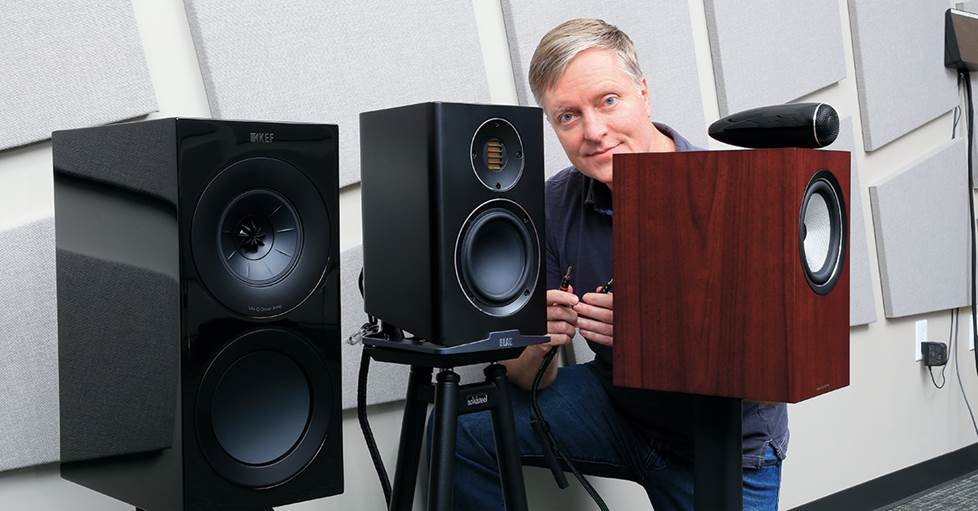
Thanks to in-house speaker demos at Crutchfield, our Advisors learn to hear contrasts between different speaker sound profiles.
It’s amazing how different speakers can sound — even playing the same song, with the same amplification. But when a group of us compare notes after listening to different speakers, we don’t always agree 100% on which sounds the best. That’s because we’re all experiencing the sound differently.
Hearing is subjective
Our hearing can be affected by minor hearing loss and other physical differences, our listening environment, and, of course, personal taste.
We try to overcome the subjectivity of sound by publishing a set of standard specifications that measure speakers’ frequency response range, sensitivity, power-handling, and so on.
But as legendary British speaker company Wharfedale’s head of acoustic design Peter Comeau puts it, “No specification tells you — the consumer, the listener — what a speaker sounds like.” For that, he says, you have to use your ears.
Speaker sound profiles explained
What makes one pair of speakers sound different from another, even if they have very similar specs? A lot of factors work together to create a speaker’s sound profile or sonic signature. Let’s take a look at what the specs can tell you.
![a photo comparing a ribbon (Air Motion Transformer [AMT]) tweeter to a soft-dome tweeter](https://canada.crutchfieldonline.com/ImageBank/v20251007133200/ImageHandler/scale/978/978/core/learn/article/5200/tweeter-types.jpg)
Most people can hear the difference between an Air Motion Transformer (AMT) tweeter and a soft-dome tweeter.
Speaker materials and construction
Different tweeter designs and materials can make an astonishing difference in a speaker’s treble sound. Other driver materials, driver layout, and cabinet construction also influence sound character. Ditto for the crossover — the circuit in a speaker that divides the audio signal between the woofer and tweeter (in a 2-way design) as well as a midrange driver (in a 3-way design).
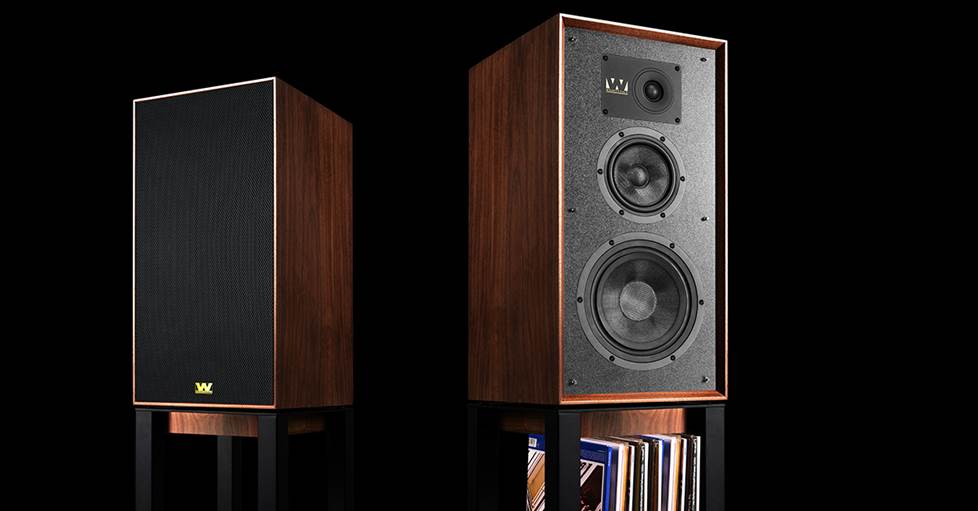
A 3-way design like Wharfedale's Super Linton can provide another layer to a speaker's sonic profile.
A speaker’s sensitivity rating is directly related to the materials and structure of its drivers. The higher the sensitivity, the louder a given speaker will play with the same amplification versus a speaker with lower sensitivity.
To learn more about speaker design and construction and how it affects sound, check out our intro to home speakers article.
Frequency response
A speaker's frequency response describes how evenly it reproduces sounds across the entire audible frequency range — from as low as 20 Hz to as high as 20,000 Hz.
Low frequencies (bass): These are the deep, resonant sounds that give music its weight and impact — think kick drums and bass guitars.
Mid frequencies (midrange): This is where vocals, guitars, and many acoustic instruments live. A clear midrange is crucial for natural-sounding music.
High frequencies (treble): These are the crisp, airy sounds like cymbals, violins, and the sparkling edges in vocals.
While a "flat" or "neutral" frequency response is often considered accurate — the speaker reproduces sound exactly as recorded — it's not always what listeners prefer. I sometimes like my dance-hall reggae best from a speaker with emphasized bass.
Common ways to describe bass, midrange, and treble
We try to talk about the finer points of how a speaker presents bass, mid, and treble frequencies. It’s not always easy, but there is some consensus on certain expressions:
Bass: Can be described as punchy, tight, deep, boomy, or even muddy. A good speaker offers defined, articulate bass without overwhelming the rest of the music. You might hear terms like "sub-bass" for the very lowest rumblings and "mid-bass" for the punchier, more impactful notes.
Midrange: This can be forward (prominent vocals), recessed (vocals sound distant), clear, natural, or sometimes harsh. A balanced midrange is key for a lifelike presentation of voices and instruments.
Treble: Often described as bright, detailed, airy, smooth, or sometimes harsh and fatiguing. Too much treble can make a speaker sound shrill, while too little can make it sound dull.
Common speaker sound profiles
So, how do you describe the sound of a speaker? Here are some common sound profiles you'll encounter:
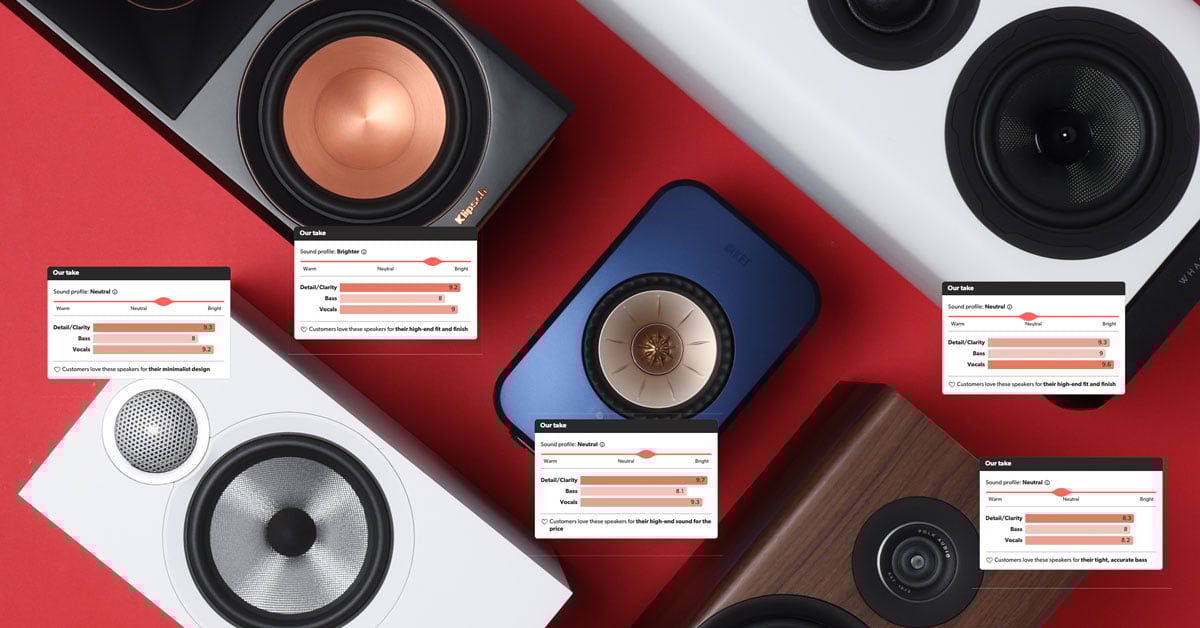
Neutral/balanced: These speakers aim for accuracy, reproducing audio as true to the original recording as possible. A model like ELAC’s Debut 3.0 DB63 doesn’t strongly emphasize any particular frequency range. If you want to hear your music exactly as the artist intended, a neutral sound profile is often a good fit. This is the hallmark of many high-fidelity (hi-fi) systems.
Warm/smooth: A warm-sounding speaker often has a slightly elevated bass response and a mellowed-out treble, like the Wharfedale Linton. This profile can be very relaxing and forgiving, making less-than-perfect recordings sound more enjoyable. It's great for long listening sessions.
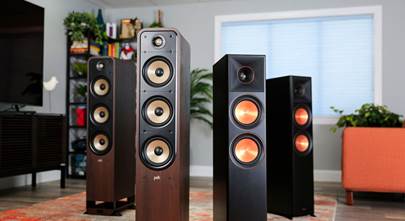
Bright/detailed: These speakers emphasize the high frequencies, bringing out lots of detail and "air" in the music. Klipsch’s RP-600M II is a great example. While exciting and revealing, they can be fatiguing if your ears are sensitive to high notes.
Punchy/dynamic: These speakers excel at reproducing the "slam" and impact of music. Revel's PerformaBe Series' flagship F328Be towers come to mind, with their super-wide 26-40,000 Hz frequency response and 3-way design with a beryllium dome tweeter, proprietary midrange driver, and trio of 8" aluminum woofers per speaker. They have excellent transient response, meaning they can go from quiet to loud very quickly, creating an engaging and lively listening experience. 3-way speakers in general tend to sound punchier thanks to the addition of dedicated midrange drivers.

When you look at any speaker on our website, you’ll get a quick snapshot of its sound profile.
Other ways to talk about sound quality
Over the course of hi-fi history, audiophiles have established more nuanced ways to talk about sound quality.
Timbre: This refers to the unique tonal quality that distinguishes one instrument or voice from another. Speakers with good timbre reproduction make instruments and vocals sound realistic, making it easier to, for example, recognize the voices of John, Paul, and George in The Beatles’ three-part harmonies.
Soundstage and imaging: A good speaker system creates a three-dimensional soundstage, making it feel like the music is happening in front of you, not just coming from the speakers themselves. Imaging is the ability to pinpoint individual instruments within that soundstage.
For a deeper dive into this type of conversation, check out our article on the language of good sound.
Sample speakers virtually with SpeakerCompare
Of course, the best way to compare speakers is to listen for yourself. But that might not be the easiest thing to do, depending on where you live. We’ve spent years developing an online tool to help customers make informed decisions.
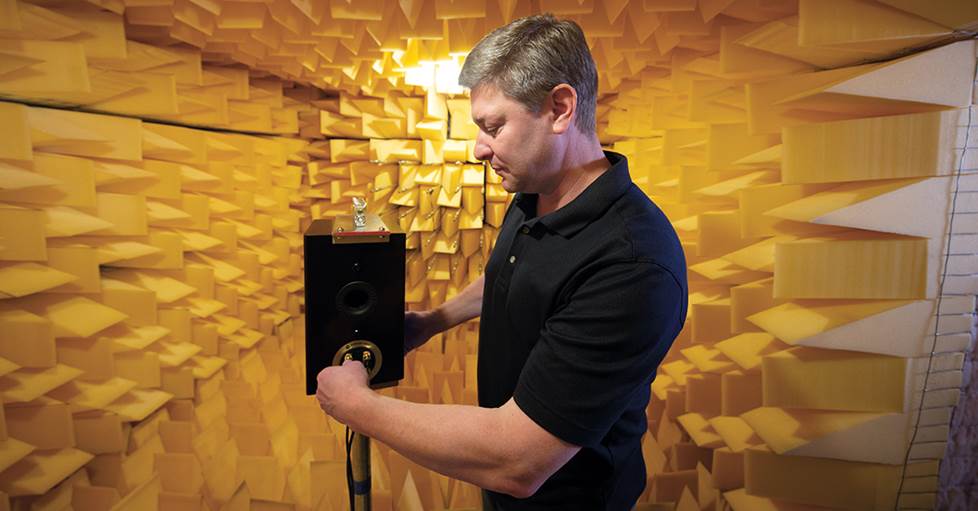
Crutchfield's anechoic chamber — where a speaker sounds most like itself — was key in developing our SpeakerCompare tool.
Our patented online SpeakerCompare tool lets you sample speakers at home. You can quickly switch between different speakers while listening to the same track — just like we would at a speaker demo here at Crutchfield — to find the sound profile you like best.
The better your headphones, the better the SpeakerCompare tool will work for you, so grab your finest. Then shop for speakers on our website and check the “Compare” box for the speakers you want to audition.
To get the most accurate comparison, choose your headphones from our list, which includes most popular brands and models. Don’t see yours? No problem — try our Listening Kit, which includes a set of professional-grade headphones.
Our customers have found this tool helpful, remarking that it’s the best option when you can’t compare the speakers in person.
Want to talk about it?
Evaluating speakers is a huge part of our job, so get in touch and lean on us when it’s time to choose. Our Advisors love to talk about the way speakers sound and have firsthand listening experience with a lot of the models we sell. They can also help if you have questions about SpeakerCompare, and generally anything related to finding the sound you want. Free lifetime tech support is included with your Crutchfield purchase.

Comments (0)