2018-2024 Nissan Kicks
How to upgrade the stereo system in your Kicks


In brief: This Crutchfield Research Garage article gives you an overview of your Nissan's stock stereo system and your aftermarket upgrade options. We'll tell you all about:
- The factory stereo system
- Removing the factory radio
- Removing the factory speakers
- Adding more bass
- Other options for your Kicks
Then, use our vehicle selector to find the gear that will fit your vehicle.
Overview of the Nissan Kicks
If you’re going to name an entry-level small SUV, you can’t do much better than “Kicks.” Cars like this (and it’s basically a very tall compact car) are not serious, gritty off-road monsters, they’re light-duty vehicles designed for city and suburban adventures.
A light-duty vehicle deserves a light-hearted name, and the Kicks more than lives up to its moniker. On the other end of the spectrum, we assume the gargantuan Nissan Armada SUV does the same.
The stock stereos range from okay to pretty good, but this quiet, efficient cruiser deserves a much better audio system. Aftermarket stereos and speakers for the Kicks aren’t that hard to find, and you can do the installation yourself for added piece of mind.
This article will show you what you can do and how to do it, so if you want to upgrade the sound in your Kicks, read on to learn more.

There are plenty of great aftermarket options if you want to replace the factory radio (Crutchfield Research Photo)
The factory stereo system
The base system is an AM/FM/SiriusXM radio with six speakers. The next step up is an 8-speaker Bose® system, and the top-of-the-line option is an 8-speaker Rockford Fosgate system. Both the Bose and Rockford Fosgate systems have their own unique amplifiers.
When you replace the factory radio, you'll lose factory features like the AUX and USB input connections, the factory satellite radio capability, and the factory backup camera, if present. We carry iDatalink packages that retain that factory backup cam in the base and Rockford Fosgate systems, but not the Bose system.
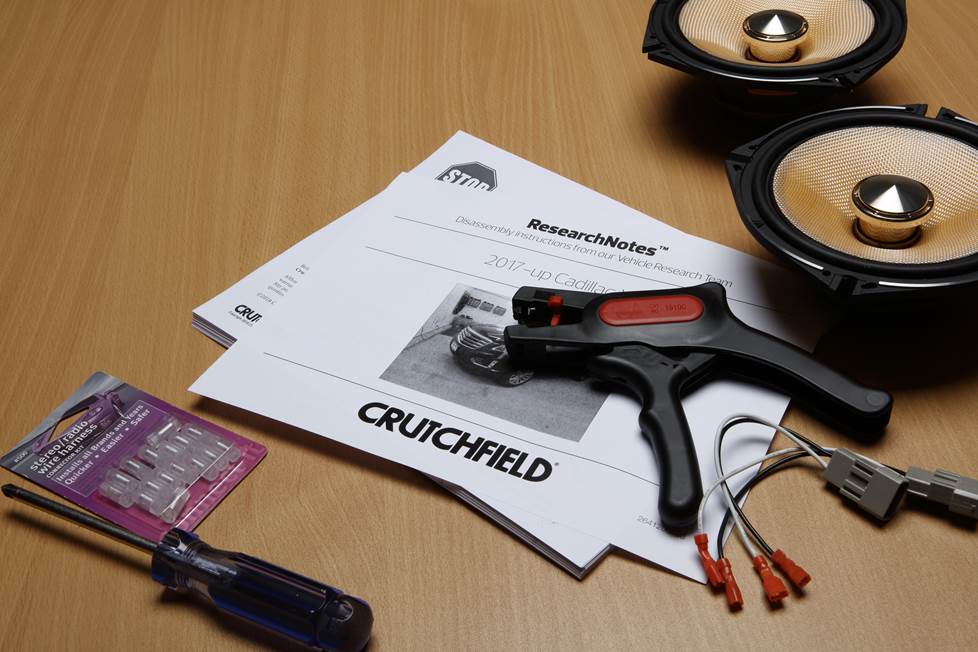
A wide variety of single-DIN (2" tall) and double-DIN (4" tall) factory radios will work in the Kicks, and when you buy your new stereo at Crutchfield, you’ll get a nice discount on the dash kit and wiring harness you’ll need to install it. You’ll also get our vehicle-specific disassembly instructions (a $10 value) free with your purchase.

The removal and replacement process is a very DIY-friendly kind of project (Crutchfield Research Photo)
Removing your factory radio
Stereo removal is pretty simple in the Kicks, no matter which stock stereo system you’re dealing with. Before you start, be sure to set the parking brake and disconnect the negative battery cable to prevent any electrical shorts. Safety first, y’know.
First off, use a panel tool to pry out the top edge of the driver's side lower dash panel, but don’t remove the panel. On the other side of the dash, open the glove box door, release the door retainer and press in the door stops, then lower the door to remove it.
Detailed stereo and speaker removal instructions
Remove the nine Phillips screws securing the glove box frame, then pull the frame toward the rear of the vehicle to release eight clips, disconnect the harness, and remove the assembly.
Next, remove the one Phillips screw securing the receiver trim panel, pry the trim panel off to release fourteen clips, and remove the panel. Remove the four Phillips screws securing the stereo to the dash, then pull the stereo toward the rear of the vehicle to release four clips, disconnect the harnesses on the back of the stereo, and remove it.
The dash kit and harness will come with their own installation instructions, so follow those to install the new stereo and hook everything up. Test the receiver and make sure it’s working before you start putting the dash back together.
Tools needed: Panel tool, Phillips screwdriver
Read our Car Stereo Buying Guide for shopping tips and advice.
Shop for car stereos that fit your Nissan Kicks
Steering wheel audio controls
In most cases, it's reasonably easy to retain your Nissan's steering wheel audio controls when you install a new stereo. When you enter your vehicle information, our database will choose the adapter you need to make your factory steering wheel controls work with a compatible aftermarket receiver.

The Rockford Fosgate amp (pictured) is a bit harder to get to than the Bose amp, but it's nothing you can't handle (Crutchfield Research Photo)
Accessing the factory amp
No matter which factory amplifier you have, it’ll be located under the front passenger's seat. You only need to access the amp if you plan to bypass it or add an additional amplifier to your system.
Getting to the Bose amp is just a matter of sliding the seat until you see the amp cover, then prying up the cover.
Reaching the Rockford Fosgate amp involves a bit more work. You’ll need to remove one Torx T50 bolt and three 15mm bolts securing the passenger’s side front seat, then lean the seat back and expose the amp location. Remove the five 7mm nuts securing the amp cover, then remove the cover.
If you bypass the factory Bose or Rockford Fosgate amp, we recommend replacing the low-impedance factory speakers with standard 4-ohm aftermarket speakers (or adding an aftermarket amplifier) to prevent overheating and other damage to your new radio.
All relevant amp wiring info will be found in the Crutchfield Research Notes included with your Crutchfield car audio purchase.
Tools needed (Bose): Panel tool
Tools needed (Rockford Fosgate): Torx T50 driver, 7mm and 15mm sockets, ratchet and extension

Upgrading the stock speakers will bring the best out of your stereo, whether it's the stock model or an aftermarket upgrade (Crutchfield Research Photo)
Removing your factory speakers
Speaker replacement is an excellent way to improve the sound in your Kicks, whether you replace the factory receiver or not. The job's not that tricky, so even if you're a relative newbie to DIY car audio, you can do the job yourself.
If you need help, remember that your Crutchfield purchase includes free tech support for the life of the gear. Our expert techs are right here in Virginia and ready to help you seven days a week.

The front tweeters are attached to the pillar trim panels (Crutchfield Research Photo)
Removing the front pillar tweeters
You’ll find 1.415" tweeters in the front pillars, and they’re reasonably easy to deal with. There are plenty of 1" aftermarket tweeters that will fit in the pillar locations, but you’ll need to use hot glue, silicone, or our universal backstraps to secure them. There’s no wiring harness available for this location, so you’ll need to splice, solder, or use Posi-Products speaker connectors to connect your new tweeters.
To remove the old ones, start at the top edge and pry off the front pillar trim panel to release two clips. Next, using needle-nose pliers, twist the panel retainer to release, then disconnect the harness and lift the panel. Remove the one Phillips screw securing the tether, then remove the panel. Remove the two Torx T20 screws securing the tweeter to the pillar trim panel and remove the tweeter.
Tools needed: Panel tool, Phillips screwdriver, Torx T20 driver, needle-nose pliers

These nifty headrest speakers are actually pretty easy to reach and replace (Crutchfield Research Photo)
Removing the headrest speakers (Bose systems only)
One of the coolest features (audio-wise, anyway) of the Kicks is the fact that the Bose system includes speakers in the headrests. Cooler still is that unlike some other headrest speaker set-ups we’ve seen, these 2-3/4" speakers are actually pretty easy to reach and replace.
Pry off the headrest grille to remove it. Next, remove the two Phillips screws securing the grille frame, then remove the frame. Remove the two Torx T20 screws securing the speaker to the headrest. Then, using a hook tool, carefully pull the speaker out of the headrest, cut the wires, and remove the speaker.
There’s no wiring harness available for this location, either, so you’ll be splicing, soldering, or using Posi-Products speaker connectors to connect the new headrest speakers.
Tools needed: Panel tool, Phillips screwdriver, Torx T20 driver, hook tool, wire cutters

There's no shortage of great aftermarket speakers that'll fit in the front doors (Crutchfield Research Photo)
Removing the front door speakers
The 2-ohm front door speakers measure 6-3/4" wired in parallel with the corresponding front pillar tweeters. There are plenty of same-size and 6-1/2" aftermarket speakers that will fit in these locations, but pay attention to the impedance numbers when you're shopping. You will need mounting brackets for some models, and we’ll include them with your order.
Depending on the speakers you choose, you may need to cut off the back of the factory plastic speaker grilles and/or remove the inner tabs on the aftermarket speaker brackets. We’ll let you know before you make your purchase, of course.
You’ll need to remove the door panels to make this upgrade, and while it’s not a hard job, there are a few steps involved. Be patient, stay organized, and work carefully. You can do this.

You'll need to remove the front door panels to get to these 6-3/4" speakers (Crutchfield Research Photo)
Starting at the top corner, pry off the sail panel to release three clips, then disconnect the harness and remove the sail panel. Remove one center pushpin clip from the upper/front corner of the door panel by first prying out the center pin, then prying out the entire clip.
Pry out the screw cover behind the door release handle, then remove one exposed 10mm screw. Next, pry out the screw cover inside the door pull cup, then remove one exposed Torx T20 screw. Starting at the rear edge, pry up the power switch panel to release eleven clips, then disconnect the harnesses, remove the switch panel, and remove the exposed 10mm screw.
Pry out the door panel to release seven clips, disconnect the door lock and release cables, then remove the door panel, and stash it somewhere safe. Finally, remove the three 10mm screws securing the speaker to the door steel, then disconnect the harness and remove the old speaker.
Once the new speakers are installed, test them out before you put the doors back together. Make sure the windows and door locks are working properly, too.
Tools needed: Panel tool, Torx T20 driver, small flat blade screwdriver, utility knife, 10mm socket, ratchet and extension

Replacing the rear door speakers is a lot like replacing the front door speakers (Crutchfield Research Photo)
Removing the rear door speakers
In the rear doors, you’ll find another set of 6-3/4" factory speakers, and these can also be replaced by same-size or 6-1/2" speakers. The speaker removal and replacement process for these doors is pretty much the same as what you do on the front doors.
But before we move on, here's a gentle reminder that replacing any of the low-impedance stock speakers with 4-ohm aftermarket models will result in lower volume levels. Pay attention to impedance when you’re shopping, and if you have any questions, our expert Advisors are here to help.
Tools needed: Panel tool, Torx T20 driver, small flat blade screwdriver, 10mm socket, ratchet and extension

This well-integrated enclosure houses the Rockford Fosgate subwoofers (Crutchfield Research Photo)
Removing the cargo area subwoofer (Rockford Fosgate only)
The Rockford Fosgate system gets boosted bass from a pair of 6-3/4" woofers installed in an enclosure in the cargo area. Replacement speakers are available, but since these speakers use proprietary Rockford Fosgate bolt patterns, you’ll need to drill new screw holes to mount your aftermarket 6-3/4" woofers.
Drilling new mounting holes isn’t the hardest DIY task ever, but you’re still drilling into your own vehicle here, so work carefully, know what’s around the area you’re drilling into, and always wear eye protection.
The factory woofers only receive bass frequencies from the Rockford Fosgate amplifier, so if you’re keeping the amp, know that the replacement speakers will only reproduce bass. On a related note, don’t forget that replacing the low-impedance factory speakers with a 4-ohm aftermarket models will result in lower volume levels. The factory models are 1.8 ohms, so 2.0 ohm models would be a good bet here.
The speaker removal/replacement process is pretty basic, and as we mentioned before, all the step-by-step details can be found in the Crutchfield ResearchNotes included with your speaker purchase.
Tools needed: Phillips screwdriver, drill with 1/8" bit
Read our Car Speakers Buying Guide for more information.
Shop for speakers that fit your Nissan Kicks

The Sound Ordnance B-8PTD powered subwoofer gives you impressive bass without taking up a lot of space
More bass in your Kicks
If you want maximum bass in your Kicks, you have a nice amount of space to work with. The actual dimensions measure 39" W x 19" H x 16"/26" D, so there’s room for a nice subwoofer enclosure here.
If you’re worried about losing cargo space, you can still pump up the low end with a more compact powered subwoofer. Learn more about building a bass system in our Car Subwoofer Buying Guide.

Protect the carpets in your Kicks with WeatherTech floor liners
Other options for your Kicks
Here are some more cool ideas for your Kicks.
Add an amplifier for better sound
If you install new speakers, consider installing a 4-channel amplifier to further improve the sound. That will let you get the best sound from your music and really fill your Kicks with sound. And if you install aftermarket subwoofers, you'll also need to install an amplifier to power them as well. Learn more about adding amps to your system in our Car Amplifier Buying Guide.
Floor mats
Daily driving can take a toll on any vehicle's carpeting. WeatherTech floor mats and liners will help protect your floors from dirt and damage.
Security
Installing a security system in your Kicks isn't easy (security systems rarely are), but it's definitely a good idea. Our Crutchfield Advisors can help figure out what you need to get the job done, but we usually recommend taking your car and new gear to a professional installer.
Let's get started!
Ready to shop? Use our vehicle selector to find the gear that will fit your Kicks or other vehicle. If you have questions, give us a shout via phone or chat.




Comments (0)